agent() Agents
Use agent() to build either a short tool-using agent or a long-horizon RLM agent with a typed final response.
auto helper = axllm::agent("question:string -> answer:string");Agents coordinate tools, child agents, runtime sessions, memories, skills, context policies, discovery, recall, shared fields, traces, usage, and final typed responses.
Pick the path by task shape:
- Short agents: quick tool calls, small child-agent composition, and compact final responses.
- Long-horizon agents: RLM runtime execution, context policy, context maps, memory, skills, and optimizer artifacts.
See short agent examples and Advanced Start for the broader Ax path.
What It Does
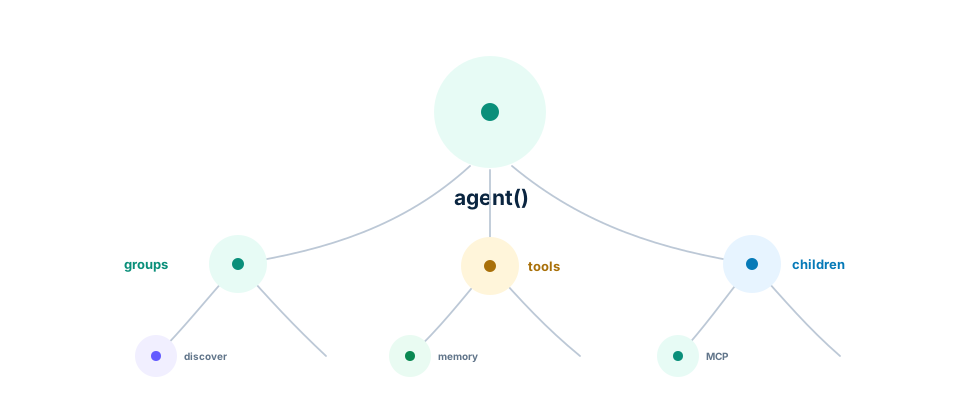
agent() creates a structured agent program. The agent planner/executor/responder loop can call tools, delegate to child agents, inspect runtime state, ask for clarification, discover tools or skills, recall memory, and finish with a typed output object.
Actor code stages request one exact javascriptCode field. Native-capable providers use strict json_schema; providers without native schema support use validated json_object, so DeepSeek Agent execution does not depend on provider-visible tools. Generated-language distiller and executor stages make one validation correction attempt by default through validation_retries; an explicit zero disables the retry.
Core Call Shape
helper = agent(signature, options)
result = helper.forward(aiClient, inputs)
Common Patterns
- Start with a signature that names the final answer fields.
- Add
fn()tools for host data and side effects. - Add child agents to the same callable list as tools.
- Use namespaces to keep tool calls readable.
- Enable discovery when available tools are too numerous to include in full.
- Save and restore state around clarification.
- Use context policies for long-running sessions.
Short agent
auto assistant = axllm::agent(
  "question:string -> answer:string",
  axllm::object({{"contextFields", axllm::array()}})
);
Stream the answer
streamingForward() runs the distiller and the executor first, then streams the responder’s answer as field deltas. A clarification or an executor error surfaces before any delta. Each delta carries a version: merge the deltas of one version (strings append, other values replace) and start over when the version changes. The citation check runs when the answer completes; an answer that cites evidence the run never gathered is sent back for a correction, which streams as a new version, and onCitations fires after the stream ends.
// The handbook stays in the agent's runtime, out of the prompt. With citations
// on, the answer cites the evidence it used, and ids the run never gathered
// are sent back to the model for a correction.
auto assistant = axllm::agent(
    "question:string, handbook:string -> answer:string",
    axllm::object({
        {"contextFields", axllm::array({"handbook"})},
        {"runtime", axllm::object({{"language", "JavaScript"}})},
        {"citations", axllm::Value::object()},
    }));
assistant.set_citations_observer([](axllm::Value ids) { std::cout << "\ncited: " << axllm::stringify(ids) << "\n"; });

// The distiller and the executor run first; then the responder's answer
// streams. Merge each delta and start over when the version changes (a retry).
axllm::runtime::quickjs::QuickJsCodeRuntime runtime;
int64_t version = 0;
assistant.streaming_forward(
    *client,
    axllm::object({
        {"question", "I downgraded today. When does it take effect, and is my data safe if I delete the workspace?"},
        {"handbook", handbook},
    }),
    axllm::object({{"runtime", axllm::Core::code_runtime_ref(runtime)}, {"max_actor_steps", 12}}),
    [&version](const axllm::AxGenDelta& delta) {
      if (delta.version != version) {
        version = delta.version;
        std::cout << "\n[retry: starting over]\n";
      }
      axllm::Value text = axllm::Core::get(delta.delta, "answer");
      if (text.is_string()) std::cout << axllm::display(text) << std::flush;
      return true;
    });
std::cout << "\n";
Namespaced tools and discovery
Use a flat functions list for small stable sets: local fn() tools, child agents, MCP clients, and runtime providers can all live beside each other. The actor sees those callables directly.
auto assistant = axllm::agent("message:string -> reply:string", axllm::object({
  {"functions", axllm::array({search})},
  {"contextFields", axllm::array({})}
}));
Use grouped functions when the catalog is large or easier to reason about by domain. Each group gives the actor a namespace plus module-level selection criteria; with functionDiscovery: true, concrete schemas are loaded only after the actor calls discover(...). You rarely need to set the flag yourself: autoUpgrade (ON by default) enables discovery automatically once the inline tool docs get large, and likewise keeps oversized input values runtime-only with a truncated prompt preview when they aren’t declared in contextFields. Explicit settings always win; pass autoUpgrade: false to opt out.
auto assistant = axllm::agent(
  "question:string -> answer:string",
  axllm::object({{"contextFields", axllm::array()}})
);
For the cross-language smart-default path, see the Smart Defaults Agent in the long-agent examples.
Grouped mode keeps big catalogs out of the prompt until needed. Keep the top-level list either flat or grouped. If a child agent belongs inside a group, pass childAgent.getFunction() inside the group’s functions list.
Memory, skills, and context policy
auto assistant = axllm::agent(
  "question:string -> answer:string",
  axllm::object({{"contextFields", axllm::array()}})
);auto assistant = axllm::agent(
"question:string -> answer:string",
axllm::object({{"contextFields", axllm::array()}})
);Connect MCP servers
MCP clients can be passed as tool providers after initialization. Use the flat form when the server exposes a small, obvious tool set.
axllm::AxMCPClient client(transport);
client.init();
auto assistant = axllm::agent("request:string -> response:string", axllm::object({
  {"functions", client.to_function()},
  {"functionDiscovery", true},
  {"contextFields", axllm::array({})}
}));
Use grouped discovery when an MCP server has many tools, prompts, or resources. The group gives the actor a namespace and selection criteria before it asks to see detailed schemas.
auto assistant = axllm::agent("request:string -> response:string", axllm::object({
  {"functions", axllm::array({axllm::object({
    {"namespace", "memory"},
    {"title", "Memory MCP"},
    {"selectionCriteria", "Use for persistent memory lookup."},
    {"functions", client.to_function()}
  })})},
  {"functionDiscovery", true},
  {"contextFields", axllm::array({})}
}));
Production Notes
Trace actor turns, tool calls, child-agent calls, clarification, discovery, recall, context growth, token usage, and final typed outputs. Keep host functions narrow and typed. Let fatal infrastructure errors bubble; let task uncertainty become clarification or a typed final answer.
See Tools, agent() API, and MCP.