Agent Internals
AxAgent is a small, opinionated runtime built from a handful of research ideas. This page explains how it works inside — the three-stage pipeline, the distinct context objects it manages, how trajectory compaction actually decides what the model sees again, and the papers each part comes from. For usage and patterns, start at Agents; this page is the “why it is shaped this way”.
The Three Stages
Every forward() runs three programs in sequence:
flowchart LR
  A[Original typed inputs] --> B[Distiller]
  B -->|executorRequest + evidence by reference| C[Executor]
  B -->|"respond(task, evidence) — executor skipped"| D
  C -->|evidence + runtime state + final envelope| D[Responder]
  D --> E[Typed output]
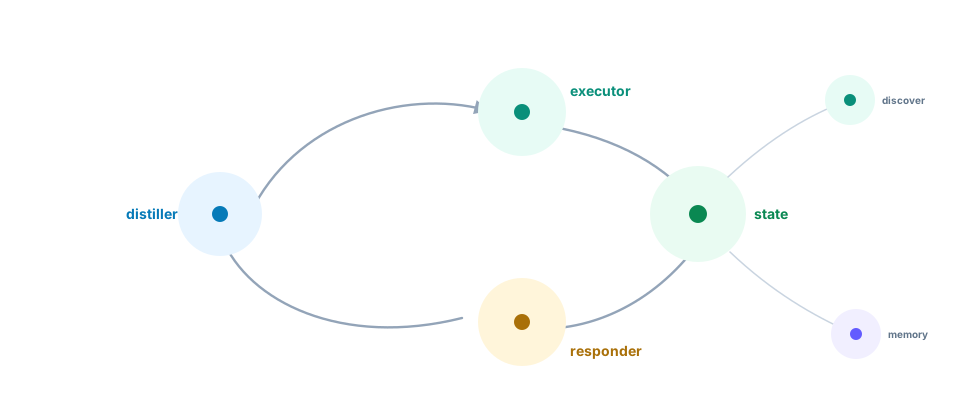
- Distiller normalizes the task and narrows large inputs down to the exact evidence the executor needs. It sees the executor’s tool and skill catalogs (so it extracts the inputs those tools will consume) but cannot call them — reconnaissance, not execution.
- Executor runs the work: tool calls, discovery, memory recall, child agents, and the final envelope.
- Responder turns the executor’s evidence into the declared output signature.
The handoff between stages is deliberately narrow. The completion primitive is final(task, context?) — exactly two arguments. Gathered evidence rides inside that optional context object; there is no separate side channel. Keeping the envelope to two positional arguments is what lets the same protocol run identically across every Ax language backend.
When the executor is skipped
Not every task needs tools. With directResponse: 'auto' (the default), the distiller can end the run with a second completion primitive, respond(task, evidence) — same two-argument envelope, different destination. The pipeline synthesizes the executor’s envelope host-side with zero executor model calls and goes straight to the responder. Two cases:
- An agent with no functions at all runs respond-only: the skip is deterministic and every run is distiller → responder.
- An agent with functions offers
respondunder a conservative covenant — only for tasks answered purely by reading the provided context, never when a registered function’s domain covers the need, never for current/live-state asks (context may be stale; tools are the source of truth for “now”), never for side effects.
Because the responder lives outside the runtime, respond’s evidence does cross into its prompt — under the same maxEvidenceChars budget that bounds every host-crossing evidence object — and the distiller’s runtime variables are exported as the cross-run state exactly as the executor’s would have been. Language ports implement the identical skip protocol. Set directResponse: 'off' to always run the executor.
The Shared Runtime Session
The distiller and executor run in one runtime session, not two. This is the difference between handing off a photocopy and handing off a shared drive: the distiller’s final(request, evidence) leaves the evidence in the session and forwards only a compact shape summary. The executor reads the real values from inputs.distilledContext — they are already live — while its prompt carries just the summary (top-level keys, types, sizes, and the field names of array items). Generated language ports use the same prompt summary contract; JavaScript-capable runtimes share the session directly, and non-JavaScript runtimes preserve the same executor-facing shape with a fallback handoff.
Two consequences fall out of this:
- Executor prompt size is decoupled from evidence size. A 5-row slice and a 5,000-row slice produce the same small summary in the prompt; the data itself never inflates the context window. Whatever the distiller discovered (tool docs, loaded skills, recalled memories) carries forward too, so the executor starts warm instead of re-discovering.
- The acting stage never has bulk untrusted context pasted into its prompt. The stage that reads the raw long context has no tools; the stage with tools reads distilled values by reference. Untrusted content still reaches the model only through the one labeled, size-bounded action-log channel — the same guarantee, now structural.
Because the executor writes code against values it cannot see, the summary lists the real field names of the evidence (e.g. item keys: id, vendorId, amountCents). Without that, models guess field names — amount instead of amountCents — and silently produce zeros; with it they write against the actual shape. The same shape hints appear in Context Metadata for the raw context fields, which remain readable in the executor as a fallback when the distilled evidence is insufficient.
The Context Objects
The most important internal idea is that “context” is not one thing. AxAgent manages four distinct objects, each with its own scope, lifetime, and mechanism — and each grounded in a different paper. Confusing them is the usual source of context-management mistakes.
| Object | Scope | Mechanism | Lineage | Ax surface |
|---|---|---|---|---|
| Context map | a recurring external corpus (a repo, doc set, dataset) | persistent orientation cache, curated by distill → cartograph → evict | PEEK | contextMap |
| Trajectory compaction | one run’s action log | hindsight ranking, tombstones, and checkpoints under a budget | RLM | contextPolicy presets |
| Strategy playbook | a task, learned offline | generation → reflection → curation into reusable bullets | ACE | agent.optimize(...) |
| Instruction text | a program, learned offline | reflective Pareto evolution of prompts | GEPA | agent.optimize(...) |
| Retrieved facts & guides | a turn | searched on demand, injected for one turn | — | recall / skills |
Two of these live at runtime (context map, trajectory compaction), two are offline optimizers (playbook, instructions), and one is per-turn retrieval. They compose rather than compete:
flowchart TB
  Corpus[Recurring corpus] -->|contextMap · PEEK| EX[Executor]
  Trajectory[This run's turns] -->|contextPolicy · hindsight| EX
  Strategy[Task strategy] -->|optimize · ACE + GEPA| EX
  Retrieval[Facts and guides] -->|recall · skills| EX
  EX --> Out[Typed output]
A useful rule of thumb: use a context map when many tasks ask different questions over the same large material; use a context policy when one long run needs its own history kept under control; use optimization to improve strategy or instructions offline; use recall/skills to pull in only what a single turn needs.
Trajectory Compaction (Internals)
Within a single run, the executor’s action log would grow without bound. The context policy decides what is replayed into the prompt each turn — without erasing runtime state, which stays alive in the session. The decision is made by hindsight: each step is scored after it runs, and the resulting plan keeps what still matters and compacts the rest.
- Hindsight ranking scores each completed step (foundational, pivot, dead-end, superseded) and ranks it 0–5. Low-value steps become eligible for compaction.
- Tombstones replace a resolved error (and its failed attempts) with one compact line, so the model remembers the lesson without re-reading the failure.
- Checkpoints summarize older trajectory into a structured ledger once the prompt crosses a budget threshold, while keeping recent working state verbatim.
Presets tune how aggressive this is:
| Preset | When to use |
|---|---|
full | Short tasks, debugging, weaker models that need exact replay |
checkpointed | General default for real multi-turn agent work |
adaptive | Summarize older successful work sooner |
lean | Very long runs with strong models and tight prompt pressure |
All of this is observable. The onContextEvent callback emits a budget_check every turn (with the live mutable prompt size and pressure level) plus action_compacted, checkpoint_created, and tombstone_created events. Aggregating that stream gives the headline numbers worth tracking: peak prompt size, compaction ratio, and cumulative tokens. Sweeping the presets on a long-horizon task is the cleanest way to see the tradeoff — raw replay keeps the most context but costs the most tokens, while the trimming presets cut peak size and token cost at some risk to answer completeness.
Does It Hold Up?
Measured behavior — the reproducible grounded-audit example, the comparison against the prior pipeline, model guidance, and what we explicitly do not claim — lives on the Performance page.
Lineage
- DSPy — declarative, typed model programs; the foundation for signatures and optimization.
- RLM (Recursive Language Models) — treat a long context as an external environment the model inspects through bounded, tool-mediated turns; the basis for runtime state and small-context turns.
- PEEK — context maps as persistent orientation knowledge about a recurring corpus.
- ACE — evolving context playbooks via generation, reflection, and curation; shipped as an optimizer alongside GEPA.
- GEPA — reflective prompt evolution over a Pareto frontier.
- Reflexion / ExpeL — reflect on failed attempts and persist the lessons across runs; the lineage behind the agent
playbookoption’s run-end failure learning. - Self-RAG / Attributed QA — citation-aware generation and measurable attribution; the lineage behind validated
citations. - Self-Harness / STOP / Darwin Gödel Machine — mine weaknesses from real traces and keep only self-modifications that provably improve; the lineage behind
agent.playbook().evolve()’s regression-gated verify mode.
See the full Research Map for papers and how each maps to Ax.