LLMs
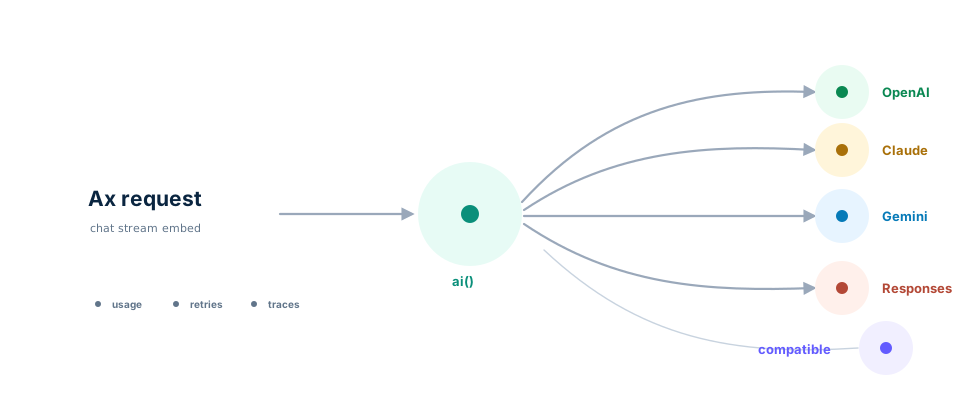
The ai() layer owns provider clients and model traffic. It keeps Ax programs focused on signatures while one provider surface handles chat, streaming, embeddings, media, usage normalization, thinking controls, routing, balancing, tracing, and provider-specific behavior.
import { AxAIOpenAIModel, ai } from '@ax-llm/ax';

const openai = ai({
  name: 'openai',
  apiKey: process.env.OPENAI_APIKEY!,
  config: { model: AxAIOpenAIModel.GPT4OMini },
});
Provider Setup
Create provider clients near the application boundary, keep keys in environment variables, and pass the client into forward(), agents, flows, or optimizers.
OpenAI
import { AxAIOpenAIModel, ai } from '@ax-llm/ax';

const openai = ai({
  name: 'openai',
  apiKey: process.env.OPENAI_APIKEY!,
  config: { model: AxAIOpenAIModel.GPT4OMini },
});
OpenAI Responses
const responses = ai({
  name: 'openai-responses',
  apiKey: process.env.OPENAI_APIKEY!,
  config: { model: 'gpt-4.1-mini' },
});
Claude / Anthropic
import { AxAIAnthropicModel, ai } from '@ax-llm/ax';

const claude = ai({
  name: 'anthropic',
  apiKey: process.env.ANTHROPIC_APIKEY!,
  config: { model: AxAIAnthropicModel.Claude48Opus },
});
Gemini
import { AxAIGoogleGeminiModel, ai } from '@ax-llm/ax';

const gemini = ai({
  name: 'google-gemini',
  apiKey: process.env.GOOGLE_APIKEY!,
  config: { model: AxAIGoogleGeminiModel.Gemini25Flash },
});
OpenAI-Compatible Providers
Use apiURL when a provider shares the OpenAI wire shape but uses a different host or model naming scheme.
const compatible = ai({
  name: 'openai-compatible',
  apiKey: process.env.PROVIDER_API_KEY!,
  apiURL: 'https://provider.example/v1',
  config: { model: 'provider/model-name' },
});
Jev and OpenAI Decisions
Use the typesafe or openai-decisions provider profile for required boolean,
class, and rubric score signatures. Add (evidence) to retain probabilities and
native confidence through your Ax program. See decision evidence.
Use the separate native clients for advanced structured criteria and request
features. Typesafe/Jev defaults to jev-latest; OpenAI Decisions defaults to
gpt-6-luna. Prose and tools need a generative step. See the Typesafe/Jev skill
for conversion settings and question design. TypeScript, Python, Java, C++, Go,
and Rust all support both interfaces, with signature, native, and hybrid examples
in each language’s generation gallery.
Model Catalog
Use the model catalog before runtime when a UI or router needs model choices, costs, and capabilities. It can filter for text, code, embedding, and audio models, and reports provider/model portable thinking levels plus verified explicit service tiers. Provider capabilities describe the default deployment profile; static model entries carry their resolved capability arrays.
import { axGetSupportedAIModels } from '@ax-llm/ax';

const textModels = axGetSupportedAIModels({ type: 'text' });
const audioModels = axGetSupportedAIModels({ type: 'audio' });
console.log(textModels[0]?.models[0]?.promptTokenCostPer1M);
flowchart LR A[Model catalog] --> B[Capability filter] B --> C[Text] B --> D[Embeddings] B --> E[Audio] C --> F[Route or select model] D --> F E --> F
Routing And Balancing
Routing has two distinct jobs. The multi-service router combines provider model lists and dispatches the model key the caller already chose; it does not select a model. AxBalancer handles equivalent services behind shared model aliases, preserving the Ax request shape while applying capability filters and provider failover.
ProviderRouter selects by request capability and degrades media only when the
selected provider cannot handle it. An image-capable provider receives native
image parts unchanged, including their payload, MIME type, detail level, cache
and optimization hints, alt text, and ordering with surrounding text.
Every supported language can opt into adaptive AxBalancer routing. It learns transient provider failure rate and successful latency, then weighs the probability of a failure or deadline miss against estimated request cost. This is operational provider selection, not semantic prompt-to-model selection, so every model behind an alias must be an acceptable substitute.
import { AxBalancer, AxInMemoryBalancerStatsStore } from '@ax-llm/ax';

const statsStore = new AxInMemoryBalancerStatsStore();
const routeKeys = new Map<string, string>([
  [openai.getId(), 'openai-primary'],
  [anthropic.getId(), 'anthropic-primary'],
]);

const llm = AxBalancer.create([openai, anthropic] as const, {
  strategy: {
    type: 'adaptive',
    deadlineMs: 6_000,
    badOutcomeCost: 0.02,
    expectedTokens: { promptTokens: 1_200, completionTokens: 300 },
    namespace: 'support-summary-v1',
    routeKey: (service) => {
      const key = routeKeys.get(service.getId());
      if (!key) throw new Error('Missing stable route key.');
      return key;
    },
    slice: ({ options }) =>
      options?.customLabels?.workflow ?? 'default-workflow',
    statsStore,
    onRoutingEvent: (event) => {
      if (event.type === 'selected' || event.type === 'fallback') {
        console.log('route:', event);
      }
    },
  },
});
Embeddings
Embeddings live on the same provider client surface. Use them for retrieval indexes, memory search, context lookup, and similarity workflows while keeping embedding model selection separate from generation model selection.
const { embeddings } = await openai.embed({
  texts: ['typed LLM programs', 'runtime agents'],
  embedModel: 'text-embedding-3-small',
});
Audio, Realtime, And Responses
Ax maps batch transcription, batch speech, conversational audio, OpenAI Responses audio, and realtime event folding where supported. Direct ax(...) programs can pass media to compatible models; agents usually transcribe audio before planner/executor/responder stages.
const transcript = await openai.transcribe({
  audio: { data: base64Wav, format: 'wav' },
  model: 'gpt-4o-mini-transcribe',
  language: 'en',
});

const speech = await openai.speak({ text: transcript.text, model: 'gpt-4o-mini-tts', voice: 'alloy' });
Thinking And Context Caching
Thinking controls expose provider-specific reasoning budgets through one Ax option. Context caching marks stable prompt regions so providers with prefix caching can reuse expensive context.
For OpenAI GPT-5.6 Chat, Ax emits explicit stable message breakpoints only when
caching is requested and forwards promptCacheKey from AxGen. Older models,
Azure, Responses, and uncached calls keep their existing request shape, except
that every OpenAI Responses request sends prompt_cache_key, from
promptCacheKey, else sessionId. For
Vertex Gemini and Anthropic, project and region select global, US/EU
multi-region, or regional routes; bearer-token lifecycle remains host-owned.
const res = await claude.chat(
  { chatPrompt: [{ role: 'user', content: 'Review this design.' }] },
  { thinkingTokenBudget: 'medium', showThoughts: true }
);
console.log(res.results[0]?.thought);
flowchart TB A[Stable context field] --> B[Cache breakpoint] C[User query] --> D[Generation] B --> D E[thinkingTokenBudget] --> D D --> F[Usage + trace]
Production Notes
- Keep provider keys outside source code.
- Ax-managed Gemini caches recover from failed TTL refreshes by recreating or going uncached; a provider-rejected stale cache receives one bounded uncached retry.
- Use the same stable OpenAI prompt-cache key for one append-only conversation; changing the key or early message breakpoints forfeits reuse.
- Namespace external context-cache registry keys by a required tenant/account ID when cross-account sharing is unsafe; use the provider expiry for the backing-store TTL.
- Prefer model aliases like
fast,smart, orcheapwhen app callers should not know provider model IDs. - Trace request latency, retries, token usage, cost, route choice, media mode, and model key.
- Keep public provider examples separate from internal conformance fixtures.
- Use OpenAI-compatible clients for generated-language package examples when that is the supported provider path.
See ai() LLM models and ai() API.