Optimization
Optimization means measuring a program and improving the parts that affect quality: instructions, demos, tool descriptions, templates, component maps, or saved optimizer artifacts.
For TypeScript, use the top-level optimize(...) helper for normal AxGen and Flow tuning, and agent.optimize(...) for agent-specific tuning. Generated languages expose the AxIR-supported optimizer surface, usually around AxGEPA and artifact application.
import { AxAIOpenAIModel, ai, ax, optimize } from '@ax-llm/ax';

const program = ax('emailText:string -> priority:class "high, normal, low"');
const studentAI = ai({ name: 'openai', apiKey: process.env.OPENAI_APIKEY!, config: { model: AxAIOpenAIModel.GPT54Mini } });
const teacherAI = ai({ name: 'openai', apiKey: process.env.OPENAI_APIKEY!, config: { model: AxAIOpenAIModel.GPT54 } });
const metric = ({ prediction, example }: any) => prediction.priority === example.priority ? 1 : 0;

const result = await optimize(program, train, metric, { studentAI, teacherAI, maxMetricCalls: 40 });
program.applyOptimization(result.optimizedProgram!);
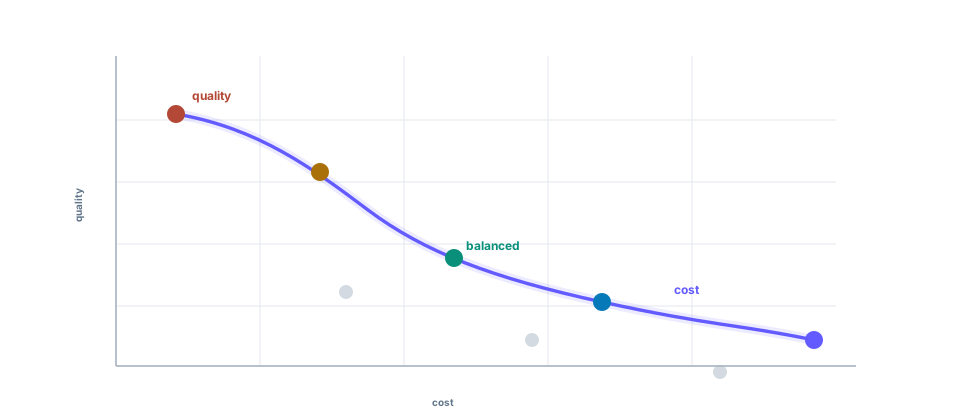
GEPA is useful when accuracy, cost, latency, brevity, tool-use quality, or policy quality are real tradeoffs. The output can be a Pareto frontier instead of one fake “best” prompt.
What You Provide
- A program to tune.
- Training examples with the same input/output shape as the signature.
- A metric or judge that scores predictions.
- Optional validation examples for holdout selection.
- Student and teacher model settings where the language surface supports them.
- A
maxMetricCallsbound so the optimizer cannot spend without limit.
flowchart LR
  A[Program] --> D[Optimizer]
  B[Train examples] --> D
  C[Metric or judge] --> D
  E[Validation examples] --> D
  D --> F[Optimized artifact]
  D --> G[Pareto frontier]
AxGen Example
Use this for a single structured generator. Keep the metric deterministic when the expected output is easy to score.
const classifier = ax('emailText:string -> priority:class "high, normal, low"');
const metric = ({ prediction, example }) =>
  prediction.priority === example.priority ? 1 : 0;

const result = await optimize(classifier, train, metric, {
  studentAI,
  teacherAI,
  validationExamples,
  maxMetricCalls: 120,
});
classifier.applyOptimization(result.optimizedProgram!);
Flow Example
Flows expose multiple optimizable components. Use multi-objective metrics when a workflow must balance accuracy with brevity, cost, or latency.
const wf = flow<{ emailText: string }>()
  .n('classifier', 'emailText:string -> priority:class "high, normal, low"')
  .n('rationale', 'emailText:string, priority:string -> rationale:string')
  .e('classifier', (s) => ({ emailText: s.emailText }))
  .e('rationale', (s) => ({ emailText: s.emailText, priority: s.classifierResult.priority }))
  .r((s) => ({ priority: s.classifierResult.priority, rationale: s.rationaleResult.rationale }));

const result = await optimize(wf, train, multiObjectiveMetric, { studentAI, teacherAI });
Agent Example
Use agent.optimize(...) for tool-use, clarification, delegation, and final-response behavior. The normal path starts with task records containing input, criteria, and optional expectedActions or forbiddenActions.
const result = await supportAgent.optimize(tasks, {
  judgeAI,
  judgeOptions: { description: 'Prefer correct tool use over polished wording.' },
  bootstrap: true,
  maxMetricCalls: 24,
});
supportAgent.applyOptimization(result.optimizedProgram!);
Verified Playbook Learning
Failure-driven repair lives on the playbook, not on a separate method: the agent-bound playbook evolve method grows the agent’s playbook from a task set. It runs the train tasks as a failure corpus, clusters the failures deterministically by error signature, mines each cluster for a grounded weakness (evidence quotes must literally appear in the failing runs’ excerpts — fabricated diagnoses are discarded), and proposes one bounded playbook bullet per weakness. With verify (default on) a bullet is kept only when the train score improves by minHeldInGain AND the validation score does not drop by more than epsilon — rejected bullets roll back exactly. verify: false applies the mined lessons without the gate (trust-batch). The engine is an implementation detail hidden behind the method, exactly as optimize(...) hides its optimizer.
Mining and judging need strong models; with weak teachers, weaknesses fail the grounding check and little is accepted. On small task sets, set runsPerTask to 2 or 3 so accept decisions compare averaged scores instead of trusting a single (possibly lucky) run per task. TypeScript and all five generated packages share the miner, grounding, budget, gate, and exact-rollback contract. Scoring remains host-shaped: TypeScript uses its metric, Python/Java/Go can accept a metric callback, and every generated port can use task scores plus the agent evaluation result.
const result = await support.playbook().evolve(
  { train, validation },
  { metric, maxProposals: 2, runsPerTask: 2, verbose: true }
);
Lineage: Self-Harness (mine weaknesses, validate edits), STOP (recursive improvement needs strong models), and the Darwin Gödel Machine (keep only what provably improves) — see the Research Map.
optimize() vs the playbook
| Use | When |
|---|---|
agent.optimize(...) | Maximize a metric over a labeled dataset by tuning instructions and demos |
The playbook option / agent.playbook().update(...) | Accumulate reusable lessons continuously (trust) — automatically from each run’s failures |
agent.playbook().evolve(dataset) | Grow the playbook from a task set, keeping only verified, rollback-safe lessons |
Metrics And Judges
| Scoring path | Use when |
|---|---|
| Deterministic scalar metric | The expected answer or action is clear |
| Multi-objective metric | You need visible tradeoffs such as accuracy vs brevity |
Plain typed AxGen judge | Non-agent qualitative scoring needs an LLM |
Built-in agent.optimize(...) judge | Agent behavior needs holistic review |
Normalize scores to 0..1 when possible. Keep objective names stable across calls.
Bootstrap And GEPA Together
Bootstrap demos are useful for small starter sets because they seed the model with concrete successful examples before GEPA mutates instructions/components. TypeScript optimize(...) composes the practical bootstrap-plus-GEPA path. Generated languages expose the optimizer primitives supported by their AxIR contract.
Artifacts
Optimization output is model-adjacent configuration. Save it, version it, record the examples and metrics used, and apply it through the program or agent API rather than manually patching instructions.
import { axDeserializeOptimizedProgram, axSerializeOptimizedProgram } from "@ax-llm/ax";

const saved = axSerializeOptimizedProgram(result.optimizedProgram!);
const restored = axDeserializeOptimizedProgram(saved);
program.applyOptimization(restored);
Budget Discipline
- Always set
maxMetricCallsin docs and examples. - Use distinct validation examples when selecting a best candidate.
- Start with small
numTrialsand scale once the metric is stable. - For trees, inspect optimized component keys so you know what changed.
- Persist artifacts only after a held-out or smoke run proves they help.
See optimize() GEPA and optimize() API.